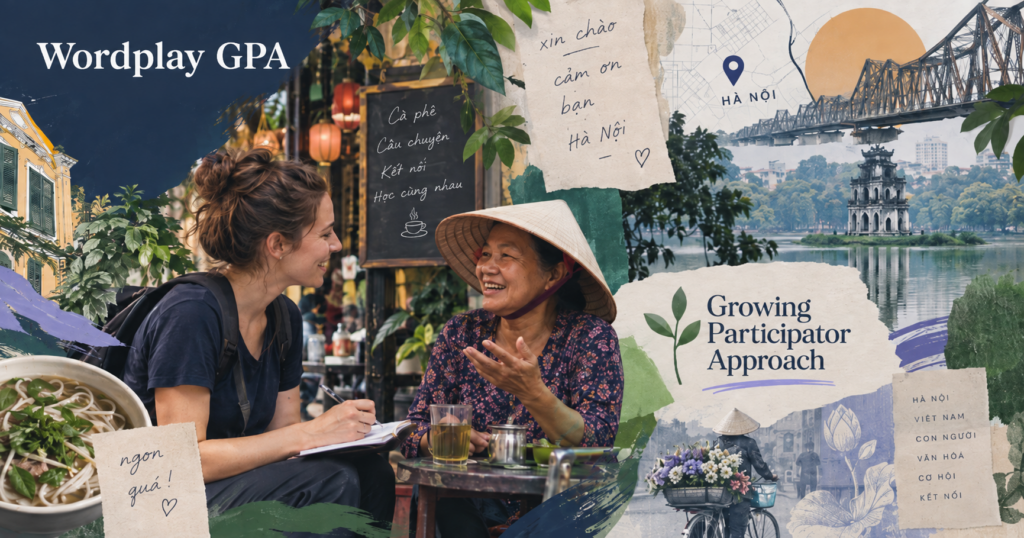
Learning Vietnamese through the Growing Participator Approach (GPA) is designed for people whose goal is not simply to memorize vocabulary or pass a test, but to actually participate in everyday life in Vietnam.
The Growing Participator Approach, usually called GPA, takes a different approach to language learning. Instead of beginning primarily with grammar explanations, translation, and memorized word lists, GPA helps learners grow into increasingly confident participants in the language and culture around them.
For people living in Hanoi, that means learning Vietnamese through interaction, relationships, stories, shared experiences, and gradually deeper participation in Vietnamese life.
What is the Growing Participator Approach?
The Growing Participator Approach is a language-learning approach developed around the idea that learning a language involves more than accumulating vocabulary and grammar.
A learner is not simply studying Vietnamese from the outside. Over time, the learner becomes a growing participator in Vietnamese-speaking relationships, situations, and communities.
Early learning focuses heavily on understanding meaning through what is happening in the moment. As learners develop, they move toward stories, shared experiences, deeper conversations, and eventually increasingly natural communication between native speakers.
The goal is not merely to know more Vietnamese. It is to become increasingly able to understand, communicate, relate, and participate.
How is GPA different from a traditional Vietnamese class?
Many traditional language courses begin with written vocabulary, grammar rules, translation, and exercises.
Those tools can be useful, but GPA begins from a different question:
How can a learner start understanding and participating in communication even before they know very much of the language?
In the early stages, learners use objects, pictures, actions, locations, gestures, and other shared context to understand what a Vietnamese speaker is communicating.
Instead of translating every sentence into English, the learner gradually becomes better at processing meaning directly in Vietnamese.
As ability grows, the activities grow with it.
A learner may move from identifying and interacting with physical objects to understanding stories, discussing shared experiences, listening to increasingly complex speech, and participating in deeper relationships.
What is a GPA nurturer?
In GPA, the Vietnamese person working with the learner is often called a nurturer.
A nurturer is more than someone who simply explains vocabulary or corrects grammar. The nurturer helps create experiences in which the learner can understand and interact with Vietnamese at an appropriate level.
Especially during the early phases, a good nurturer learns how to make communication understandable without constantly falling back on English translation.
As the learner develops, the nurturer helps provide increasingly rich Vietnamese language and cultural interaction.
This relational part of GPA is important because language is not separated from the people who speak it.
What are the six phases of GPA?
GPA is organized into six broad phases. Each phase reflects a different stage in the learner’s ability to understand and participate.
Phase 1 — Here & Now
The learner builds a foundation by interacting with language connected to things that can be seen, touched, demonstrated, or experienced in the moment.
Wordplay uses an approximate target of 80–120 guided hours for Phase 1.
Phase 2 — Story Building
The learner begins working much more with stories and sequences of events.
Instead of communication depending only on what is physically present, learners develop their ability to understand people talking about things that happened.
Approximate guided time: 150 hours.
Phase 3 — Shared Experience
Language becomes increasingly connected to shared experiences and richer communication.
Learners continue developing listening comprehension while becoming able to participate in more complex interaction.
Approximate guided time: 250 hours.
Phase 4 — Deep Relationship
At this stage, learners are able to engage with much more complex language and increasingly meaningful relationships.
Approximate guided time: 500 hours.
Phase 5 — Native-to-Native
Learners spend significant time engaging with communication originally intended for native Vietnamese speakers.
The goal is increasingly natural participation in the language world around them.
Approximate guided time: 500 hours.
Phase 6 — Lifelong Growth
There is no final point at which a person has experienced everything a language and culture can offer.
Phase 6 recognizes language development as an ongoing, lifelong process of participation, relationship, and growth.
How long does it take to learn Vietnamese with GPA?
There is no single timeline because learners study at very different intensities.
Using the approximate guided-hour ranges above, Phases 1 through 5 represent roughly 1,500 guided hours of development.
Someone studying many hours each week will naturally progress much faster than someone meeting only occasionally.
Consistency matters because GPA is designed around sustained exposure, interaction, and participation rather than isolated lessons.
The objective is not to race through phases. Each phase is meant to give the learner the experiences needed for the next level of participation.
Is GPA good for complete beginners?
Yes. In fact, the earliest part of GPA is specifically designed around a learner who does not yet understand much Vietnamese.
A beginner does not need to wait until they have memorized hundreds of words before they can begin interacting.
Activities are structured so that meaning can be understood through context, allowing the learner’s comprehension to grow from the beginning.
Over time, the amount and complexity of Vietnamese can increase naturally.
Who is GPA a good fit for?
GPA can be especially valuable for people who:
- live in Vietnam and want to communicate in everyday life
- value relationships and cultural understanding
- want to develop natural listening ability
- want to participate more confidently in Vietnamese-speaking environments
- prefer learning through interaction and experience
- are prepared to invest consistent time in language development
Someone whose primary goal is an academic examination or a highly grammar-focused course may need additional resources designed specifically for that purpose.
Why study GPA while living in Hanoi?
Hanoi gives Vietnamese learners an enormous advantage: the language is happening around them every day.
A GPA session is not meant to remain disconnected from the learner’s real life.
The Vietnamese understood during a session can begin appearing again in conversations, shops, neighborhoods, friendships, workplaces, and everyday experiences.
As learners understand more of what is happening around them, Hanoi itself becomes part of the learning environment.
That is one of the strengths of learning Vietnamese through participation rather than treating the language only as an academic subject.
Studying the Growing Participator Approach with Wordplay in Hanoi
Wordplay GPA supports Vietnamese learners in Hanoi through trained language-helper matching, starting consultation, ongoing coaching, phase guidebooks, and learning materials.
The program is designed for people who want Vietnamese to become part of their actual life in Vietnam rather than simply another subject they study.
You can learn more about the program, the six phases, study requirements, and current hourly pricing on our Growing Participator Approach program in Hanoi page.
As GPA creator Greg Thompson expressed it:
“It’s not just a language to learn, but a life to live!”
Ready to Learn Vietnamese Through Wordplay GPA in Hanoi?
Wordplay offers a structured Growing Participator Approach program in Hanoi with trained Vietnamese nurturers, coaching, materials, and support throughout the six-phase GPA journey.
